Archiv der Kategorie: English
Merry Something
Statistics quote
This might be true not only for psychology:
“Data without theory have a low life expectancy, like a baby without a parent. We need to develop more theoretical courage.”
Gerd Gigerenzer, quoted in: Null Science: Psychology’s statistical status quo draws fire
Once upon a time,
… when computer worms were so rare they made it into the news even though they did not do much harm to anybody:
(link)
In einem Wort
Kerberos protects your password
(link)
In einem Wort
In einem Wort
New last.fm feature
Looks like last.fm can predict future listening:
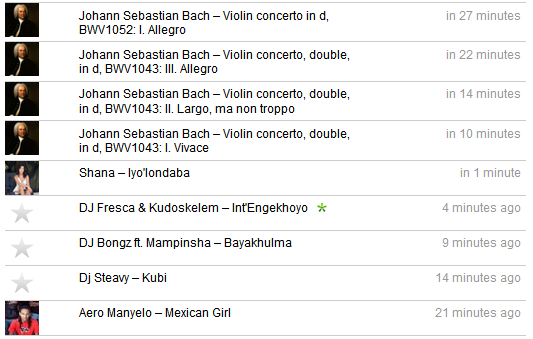
Of course this is really just a time calculation bug, the music listed itself properly represents my recent past listening. What amazes me, though, is the smoothness of this bug from a user interface perspective. It does not look like a bug at all. It does not say: »-1 minute ago,« or anything obviously faulty. It rather appears as if the Web site calmly and confidently states a fact that it knows is true and accurate. Only that it isn’t.
I reckon that behind the scenes some generic library function does a good job of translating time stamps into natural-language relative descriptions such as those that we see above. This seems like a good thing in general, but we should use this opportunity to remind ourselves that bugs may not always look like bugs.
Risk taking
In einem Wort
Will better risk management make this world a better place?
»A world in which cancer is normalized as a manageable chronic condition would be a wonderful thing, but a risk-factor world in which we all think of ourselves as precancerous would not. It might decrease the incidence of some forms of malignancy while hugely increasing the numbers of healthy people under medical treatment. It would be a strange victory in which the price to be paid for checking the spread of cancer through the body is its uncontrolled spread through the culture.«
(Stephen Shapin, via)
In einem Wort
In einem Wort
Soziale Kontrolle, technisch unterstützt
»Lance Maggiacomo was out of work, bored and lonely when he started hiding his online relationships from his wife.
There was no affair, only chatting through e-mail, yet it felt like cheating just the same.
A few years later, a reformed Maggiacomo has an in-house check on his impulses. He and his wife Lori, like other Christian couples around the country, share one e-mail account as a safeguard against the ever-expanding temptations of the Internet.«
(USATODAY.com:
Christian couples share e-mail addresses to stay faithful)
In einem Wort
Child Safety Now
(directsafety, via)
Snuggly the Security Bear
ECRYPT II Yearly Report on Algorithms and Key Lengths
For those who aren’t aware of it yet: the ECRYPT II Network of Excellence maintains »a list of recommended cryptographic algorithms (e.g. block ciphers, hash functions, signature schemes, etc) and recommended keysizes and other parameter settings (where applicable) to reach specified security objectives.« This list is available as a public report, one can download the current version from their web site. If you need to assess the security and suitability of an algorithm used somewhere, this might be a valuable source.
Martial Arts
In einem Wort
Trained Monkey Effect (TME)
47 ways of manipulating people
Successful games manipulate people, creating artificial tasks and challenges that people love to spend time on. This is hard but one can learn it. Hard it is because one need to carefully balance difficulty. A game must pose a challenge to be interesting but avoid being too hard and thus frustrating. Guess why so many games come with some concept of levels of difficulty?
The learnable part is game mechanics. Game mechanics is about the building blocks of a game, design patterns for artificial tasks and challenges that engage the player. The SCVNGR Game Dynamics Playdeck documents 47 such patterns. Their use is not limited to recreational games. Applications and Web sites may employ some of the elements, and con artists and social engineers are exploiting some very similar strategies to trick people into compliance.
 Sicher ist sicher?