So, liebe Kinder, sahen die Apps aus, als es noch keine Smartphones gab:

Man muss das Geld dort abholen, wo es liegt:
»Bei 51 sogenannten Skimming-Angriffen in Frankfurt sei seit Jahresbeginn ein Schaden von 460 000 Euro entstanden, teilte die Polizei am Freitag mit. Es liegen über 400 Anzeigen vor. Im gesamten vergangenen Jahr hatte es 26 Angriffe auf Geldautomaten gegeben.«
(Echo Online:
Immer mehr Attacken auf Bankautomaten)
Zum Vergleich, die Zahlen für ganz Sachsen lagen im vergangenen Jahr in ähnlicher Höhe, während es hier nur um Frankfurt geht.
Surveillance Studies macht auf einen Beitrag im Deutschlandradio aufmerksam: Nur der Tod ist sicher, Theorie und Praxis der Risikoabwägung. Hat jemand einen Link zum Anhören gefunden oder muss das Manuskript genügen?
For those who aren’t aware of it yet: the ECRYPT II Network of Excellence maintains »a list of recommended cryptographic algorithms (e.g. block ciphers, hash functions, signature schemes, etc) and recommended keysizes and other parameter settings (where applicable) to reach specified security objectives.« This list is available as a public report, one can download the current version from their web site. If you need to assess the security and suitability of an algorithm used somewhere, this might be a valuable source.
Vortragsabend der „Darmstädter Juristischen Gesellschaft“ mit anschließender Podiumsdiskussion in Kooperation mit dem Forum für interdisziplinäre Forschung der TU Darmstadt sowie CASED.
Montag, 1. November 2010, ab 18:00 Uhr, Georg-Christoph-Lichtenberg Haus der TU Darmstadt, Dieburger Strasse 241, 64287 Darmstadt
(via)
Ob Google nun eine gefährliche Datenkrake ist oder nicht, charmant ist solch demonstrative Transparenz allemal:
»Please note that this Privacy Policy may change from time to time. We will not reduce your rights under this Privacy Policy without your explicit consent. We will post any Privacy Policy changes on this page and, if the changes are significant, we will provide a more prominent notice (including, for certain services, email notification of Privacy Policy changes). We will also keep prior versions of this Privacy Policy in an archive for your review.«
Ich kann mich nicht erinnern, so etwas schon einmal woanders gesehen zu haben.
a) Es regnet in 30 Prozent des Vorhersagegebietes (Fläche)
b) Es regnet 30 Prozent der Vorhersagezeit (Zeit)
c) In 30 Prozent der Tage mit gleicher Wetterlage (Erfahrung)
http://www.3sat.de/mediathek/mediathek.php?obj=20494&mode=play
Fefe hat ein Whitepaper zum nPA gefunden. Darin heißt es unter anderem:
»Sofern der Ausweis missbräuchlich verwendet wurde, liegt eine Täuschung des Dienstanbieters in der Person des Kunden vor. Die vom Angreifer abgegebene Willenserklärung ist für den Inhaber des Ausweises nicht bindend.«
Das ist eine sinnvolle Regelung, und wenn ich mit meinem guten Namen zahle, dann wird sie seit jeher so angewandt. Allerdings fehlt den eID-Funktionen im neuen Personalausweis ein Element, das die Abstreitbarkeit erst ermöglicht. Zu meiner Kreditkarte bekomme ich jeden Monat eine Liste der mir zugeschriebenen Vorgänge. Dieser Service fehlt dem elektrischen Ausweis.
Die Kernkraft steht wieder auf der Tagesordnung. Während die üblichen Verdächtigen ihre eingeübten Protestrituale vollziehen, denken andere nach und erinnern uns an die Realität:
Dieses Stück werde ich voraussichtlich auf der ISSE/GI Sicherheit 2010 ausführen:

(Außerdem halte ich da auch noch einen Vortrag über die pragmatische Schätzung der Angriffsfläche von Webanwendungen.)
Wie lange brauchen Sie, um den folgenden Text zu lesen? Mit einem Klick geht es zur Originalgröße.

Eingeblendet war er für ca. 2 Sekunden.
Trained Monkey Effect (TME)
So einen Aushang habe ich bisher nur einmal gesehen. Wie bringen die diesen Sermon auf dem Kassenzettel unter, den man beim Bezahlen mit Karte unterschreibt?
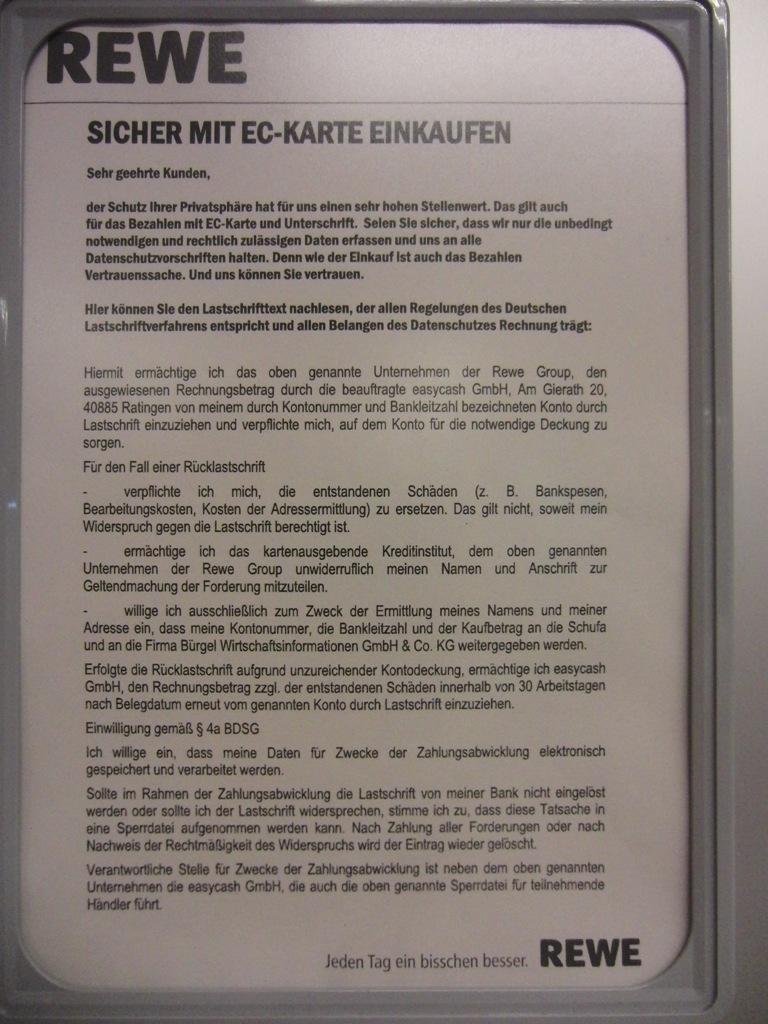
Sie haben ihre Transparenzdemonstration übrigens so aufgehängt, dass man starke Nerven braucht, um den Text zu lesen. Man steht dann nämlich hinter der Kasse im Weg.

